Monday, September 13, 2010

Maslova Recalls the Past

Tolstoy has the ability to create scenes that really have a way of leaving an impact on me. He has a balance which combines the right levels of drama and emotion and he really cracks the human character.

Again, we see his strength to articulate a human and his/her emotions in a way unlike other authors.

I’m not sure what attracts me to the scene below. Perhaps it illustrates a scene that could have played out in my own life.

From chapter XXXVII -

It was a warm, rainy, and windy autumn night. The rain now pelted down in warm, heavy drops, now stopped again. It was too dark to see the path across the field, and in the wood it was pitch black, so that although Katusha knew the way well, she got off the path, and got to the little station where the train stopped for three minutes, not before, as she had hoped, but after the second bell had been rung.

Hurrying up the platform, Katusha saw him at once at the windows of a first-class carriage. Two officers sat opposite each other on the velvet-covered seats, playing cards. This carriage was very brightly lit up; on the little table between the seats stood two thick, dripping candles. He sat in his closefitting breeches on the arm of the seat, leaning against the back, and laughed. As soon as she recognized him she knocked at the carriage window with her benumbed hand, but at that moment the last bell rang, and the train first gave a backward jerk, and then gradually the carriages began to move forward.

One of the players rose with the cards in his hand, and looked out. She knocked again, and pressed her face to the window, but the carriage moved on, and she went alongside looking in.

The officer tried to lower the window, but could not. Nekhludoff pushed him aside and began lowering it himself.

The train went faster, so that she had to walk quickly.

The train went on still faster and the window opened.

The guard pushed her aside, and jumped in.

Katusha ran on, along the wet boards of the platform, and when she came to the end she could hardly stop herself from falling as she ran down the steps of the platform. She was running by the side of the railway, though the first-class carriage had long passed her, and the second-class carriages were gliding by faster, and at last the third-class carriages still faster.

But she ran on, and when the last carriage with the lamps at the back had gone by, she had already reached the tank which fed the engines, and was unsheltered from the wind, which was blowing her shawl about and making her skirt cling round her legs. The shawl flew off her head, but still she ran on.

"…but still she ran on." Just beautiful.

There was a time in my life where I could have been Nekhludoff in that train…and someone that I loved and still love very much could have been Maslova running down the train platform.

I made a decision and “she” agreed with this decision and the scene above never played out for me.

I couldn’t leave her behind. She had too much potential and I loved her too much to not have her in my life.


Thursday, September 9, 2010

The Awakening


I feel that at the speed I am reading I’ll certainly be through with this novel by the time you are born. Completing this novel will certainly give me the strength to conquer others. Yes, I use the word conquer. Although the writing/translation has been somewhat updated, it’s still not really in the modern style that I am accustomed to in my other readings. I can hardly wait to get to my Pevear and Volokhonsky translations.

So, I’m now on page 234 and what I am doing is placing marks in the book at pages which contain passages that I would like to comment upon.

So from chapter XXVIII – “The Awakening” – I discovered the following passages that moved me.

He stopped again, folded his hands in front of his breast as he used to do when a little child, lifted his eyes, and said, addressing some one: "Lord, help me, teach me, come enter within me and purify me of all this abomination."

He prayed, asking God to help him, to enter into him and cleanse him; and what he was praying for had happened already: the God within him had awakened his consciousness. He felt himself one with Him, and therefore felt not only the freedom, fullness and joy of life, but all the power of righteousness. All, all the best that a man could do he felt capable of doing.

His eyes filled with tears as he was saying all this to himself, good and bad tears: good because they were tears of joy at the awakening of the spiritual being within him, the being which had been asleep all these years; and bad tears because they were tears of tenderness to himself at his own goodness.

He felt hot, and went to the window and opened it. The window opened into a garden. It was a moonlit, quiet, fresh night; a vehicle rattled past, and then all was still. The shadow of a tall poplar fell on the ground just opposite the window, and all the intricate pattern of its bare branches was clearly defined on the clean swept gravel. To the left the roof of a coach-house shone white in the moonlight, in front the black shadow of the garden wall was visible through the tangled branches of the trees.

Nekhlyudov gazed at the roof, the moonlit garden, and the shadows of the poplar, and drank in the fresh, invigorating air.

"How delightful, how delightful; oh, God, how delightful" he said, meaning that which was going on in his soul.

There specifically two parts to the above passage that I’d like to comment upon. From the beginning of the selection to the sentence ending with the word “goodness”, a scene is played out that I feel I have seen myself almost recreate in my own life. I have found myself – at times – before I really began to explore my relationship with a spiritual entity “requesting” some sort of assistance with a problem I was facing. I cannot say that I felt any sort of weight lifted from me or a “spirit” entering into me. I can say though that did feel some sort of “power of righteousness” and I feel that was as a direct result of me placing my faith in the action of prayer as a possible solution to the problem I was facing. I felt that the act of praying was the best that I could do and that action itself was going to solve my problem…not necessarily a “God” or “spirit”. The feeling of righteousness gained just by the act of praying is a possible reason that led me down one of my paths of exploration of my spirituality and faith.

The second selection from that passage above is where Nekhlyudov is gazing at the scene outside of his window.

With my inability to completely relate to Nekhlyudov in the first part of the above passage, with this second part, I can totally relate.

It was a moonlit, quiet, fresh night; a vehicle rattled past, and then all was still. The shadow of a tall poplar fell on the ground just opposite the window, and all the intricate pattern of its bare branches was clearly defined on the clean swept gravel. To the left the roof of a coach-house shone white in the moonlight, in front the black shadow of the garden wall was visible through the tangled branches of the trees.

Nekhlyudov gazed at the roof, the moonlit garden, and the shadows of the poplar, and drank in the fresh, invigorating air.


It was on more than one occasion that I stood in the deepest night or in the earliest of mornings in the cold crisp snow and observed the earth just as above. It was either in Vermont or in Romania. And – in keeping with Tolstoy’s philosophy of disclosure – I was probably in some sort altered state of mind which I feel I could apply to Nekhlyudov and his particular mental state which forced him to seek the intervention of ‘God”.

And now WTFED:

“When you do not work you become bored. When you are bored, you sin”

HAPPY BIRTHDAY! YOU ARE 182 YEARS OLD!

Wednesday, September 8, 2010

Monday, August 30, 2010

Cleansing of the soul


Making good progress on resurrection. Landed on page 165 this morning. I’ll pull out some passages that catch my attention either though the content it focuses upon…the general style Tolstoy uses in a passage… or the general feeling that arises after I read it.

The following is from chapter XXVIII – The Awakening

More than once in Nekhlyudov's life there had been what he called a "cleansing of the soul." By "cleansing of the soul" he meant a state of mind in which, after a long period of sluggish inner life, a total cessation of its activity, he began to clear out all the rubbish that had accumulated in his soul, and was the cause of the cessation of the true life. His soul needed cleansing as a watch does. After such an awakening Nekhlyudov always made some rules for himself which he meant to follow forever after, wrote his diary, and began afresh a life which he hoped never to change again. "Turning over a new leaf," he called it to himself in English. But each time the temptations of the world entrapped him, and without noticing it he fell again, often lower than before.


… "Have you not tried before to perfect yourself and become better, and nothing has come of it?" whispered the voice of the tempter within. "What is the use of trying any more? Are you the only one? - All are alike, such is life," whispered the voice. But the free spiritual being, which alone is true, alone powerful, alone eternal, had already awakened in Nekhlyudov, and he could not but believe it.


He prayed, asking God to help him, to enter into him and cleanse him; and what he was praying for had happened already: the God within him had awakened his consciousness. He felt himself one with Him, and therefore felt not only the freedom, fullness and joy of life, but all the power of righteousness. All, all the best that a man could do he felt capable of doing.

His eyes filled with tears as he was saying all this to himself, good and bad tears: good because they were tears of joy at the awakening of the spiritual being within him, the being which had been asleep all these years; and bad tears because they were tears of tenderness to himself at his own goodness.

I don’t think there has been an extended period of time where I have looked at myself and wished and sought help at cleansing the evil/negative/bad/wicked parts out of me. I feel that I am very critical of my psychological being. I question my decision making; I question my own self control and discipline.

How do I go about cleansing myself?

Honestly, I feel that I am seeking, and have been seeking an answer to that question for years…yes- years. I’d also like to think that some of the process of doing these readings and wrings will allow me to work on correcting what I’d like to call “character flaws”.

Do I pray?

That’s a tough one as I struggle to recognize and understand my own feelings about a “being” to “pray to”.

Am I praying to the god within me – or am I praying to the “God” that is floating up in the clouds?

Who or what am I seeking assistance from. Am I attempting to rally my own forces within me to fight against that which I am battling against – or am I seeking some sort of external assistance? Does that external existence even exist?

The real question then becomes, is this questioning of an existence a good thing or a harmful thing?

I do not see the harm in questioning the existence or lack of existence of a “being”.

What I am sure of though is that I exist and I have a voice within me that I listen to.

I think that this questioning of existence and the realization of the “being” within me is one of the reasons why I have finally been able to tackle this novel. I don’t think that Tolstoy’s writing would have held me in the past as it is doing now.

Today’s WTFED is rather fitting.

“Atheism indicates that a person has some intellect but only to a certain limited extent. Both the truly wise and the completely stupid are not atheists.”


Well now…something to dwell on.

Thursday, August 26, 2010

Settling in for the long read

So I’m 94 pages into this book…total 483.

I better get to reading if I’m going to wrap this up before the little guy arrives!

Reading at night is tough. I’m usually pretty tired by the time dinner is over and after M and I have returned from our evening walk. It’s tough to settle down in my nice comfortable (reclining) chair, pick up a book and read.

It’s so much easier to just lay back, put on a mindless TV program and drift off.

But, surprisingly, I’ve found “Resurrection” holding my attention. I was worried when I first started reading this book (and given my past history with it) that it would be hard to mentally hold this book because I really haven’t read literature in translation from this period in quite some time. My reading of short stories from the late 70s and the early 80s has really set my head in a certain frame of reading. – Does that make any sense?

In preparation and during the reading of Resurrection and for future Tolstoy novels, I have been reading opinions on the book and on his writing. I ran across this thread on a literature discussion board.

The question was asked – “Why do we study literature?” The question sounds like a student attempting to get some good answers to use as their own for the next day’s class…but I found the answers – especially the first (and the author cited was quite fitting) one to be a wonderful reason for the existence of this journal.

I think it was Leo Tolstoy who argued that all of literature, quality literature, revolves around two central issues: Who are we and how shall we live? These two questions strike at the heart of literature and provide answers to why we study literature. If we take Tolstoy's paradigm and study it, we understand why a study of literature is vital to our understanding of ourselves and our world. All literature does, to a large extent, address both questions in different ways. The answers derived help us understand our identities and purposes in this life. The manner in which these questions are answered may vary from text to text, yet the underlying premise behind why we study literature comes back to Tolstoy's predicament: We seek answers to who we are and how we shall live.

Tolstoy and his morals – I’ll be sure to include some of what John Gardner and DFW had to say about him and those in a later entry.

Here is a lovely passage – one that someday I may be able to explain to you. It’s a passage that touched my heart and took me back…

“In the love between a man and a woman there always comes a moment when this love has reached its zenith—a moment when it is unconscious, unreasoning, and with nothing sensual about it. Such a moment had come for Nekhlyudov on that Easter eve. When he brought Katusha back to his mind, now, this moment veiled all else; the smooth glossy black head, the white tucked dress closely fitting her graceful maidenly form, her, as yet, un-developed bosom, the blushing cheeks, the tender shining black eyes with their slight squint heightened by the sleepless night, and her whole being stamped with those two marked features, purity and chaste love, love not only for him (he knew that), but for everybody and everything, not for the good alone, but for all that is in the world, even for that beggar whom she had kissed.”

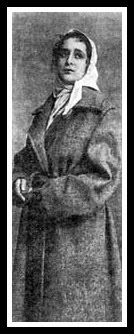
Katusha at the Easter service

I am quite fascinated with the character of Katusha. I think that because of my time in Romania… and honestly my fascination with the peasants, I can picture Katusha quite clearly.

Now, Katusha is not a peasant, she is more of a “house maid”…but I cannot seem to disassociate my mental picture of her as more of a peasant.


Again, I think that this is another wonderful aspect of literature – the author goes to great lengths to develop the character - their physical being as well as their personality and soul. It is the reader that may unconsciously assign smaller characteristics to the players in the novel as they read simply because of their own background and the filter that the story passes through in their mind colors the story in a shade that is the most pleasant to them.

Most of the action in the story since my last post has taken place in the courtroom. There was the “flashback” to the whole affair between Katusha and Nekhlyudov but it’s really hard for me to decide which was more compelling.


Katusha in court

Finally, here is another WTFED.

“There is only one type of treasure that does not get smaller when you give it to others. You can give away as much as you want, and it only grows bigger. It is the treasure of wisdom.”

Monday, August 23, 2010

What we carry on our back


I carry a backpack to work. It’s a nice large LL Bean backpack with two large cargo pockets, two small front pockets and a large cargo pocket on the bottom.

I carry my lunch in the largest of the pockets. In the second largest pocket, I carry all of my books. I rotate several magazines and papers in and out of that pocket depending on my reading choices for that week. Mixed in with the papers, are three books that remain in that pocket.

The first is the latest edition of the “Best American Short Stories” anthology that I am reading for my other journal.

The second is a physical journal. A little black notebook…you know the brand.

The third is the book pictured below.


A feature of this journal will be irregular postings of some of the thoughts by Tolstoy that I come across in this little book.

In other Russian reading news, I am a good 40 pages in “Resurrection” by Tolstoy.

Why did I choose this book as the first to read and report on in this journal?

I have a tough time knowing why. I think it will be one of those decisions that exposes itself through time.

I just finished a book (ARC) “Travels in Siberia” by Ian Frazier (I may review the book for the paper).

This book was a major part of me getting back into my “Russian” phase of reading, and it turn, I suppose a major part of the creation of this journal.

This photo – by Repin has captivated me since I purchased this novel.


As far as I can remember, the book was purchased just after me leaving Norwich. I think I was intending to purchase as many of Tolstoy’s novels as I could. I am pretty sure that I purchased my first copy of “War and Peace” right around the same time…I’d say it was 1994. There were several major book purchases during this turbulent period of my life. And I sought comfort in the Russians.

That would be 16 years ago. So, 16 years after the purchase…I am finally reading it.

I’ll have plenty to say about this book over the next few weeks, and my goal is to have this book completed by the time you are born.

So, let’s end today’s writing with a few words from ‘Wise Thoughts for Everyday” – or WTFED.

Aug 23rd

‘The majority of our actions are guided by the force of other people’s opinions and teachings.”

True – but it’s important to take those opinions and teachings with a certain amount of your own judgment.